
A Dual Switch has (2) independent micro-switches in one housing. Most commonly, a dual switch contains 2 SPDT (Single Pole, Dual Throw) switches. The key point is that there are two independent set points, each switch with its own mechanical actuator. A Dual switch is chosen if two independent set points are needed, or the user is looking for redundancy. This its typically used for setting low/high and high/high alarm limits.
A DPDT switch stands for Double Pole, Double Throw. There is one set point actuated by a single mechanical actuator, but the micro-switch includes 2 electrically independent circuits, each with a common terminal and two throws. Both poles move together, so they do not have independent actuation points. A DPDT switch is typically chosen if the user wants one actuation point, with two separate functions. A point to consider when selecting a DPDT switch is that fixed deadbands may have much wider ranges than those listed in datasheets.
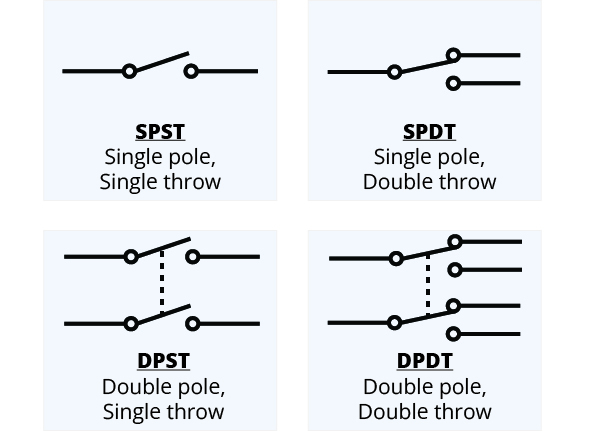
These switch specifications are often mixed up but make a big difference when it comes to selecting a model for a specific application. It is important to determine if you require two independant setpoints or one setpoint to perform two functions.
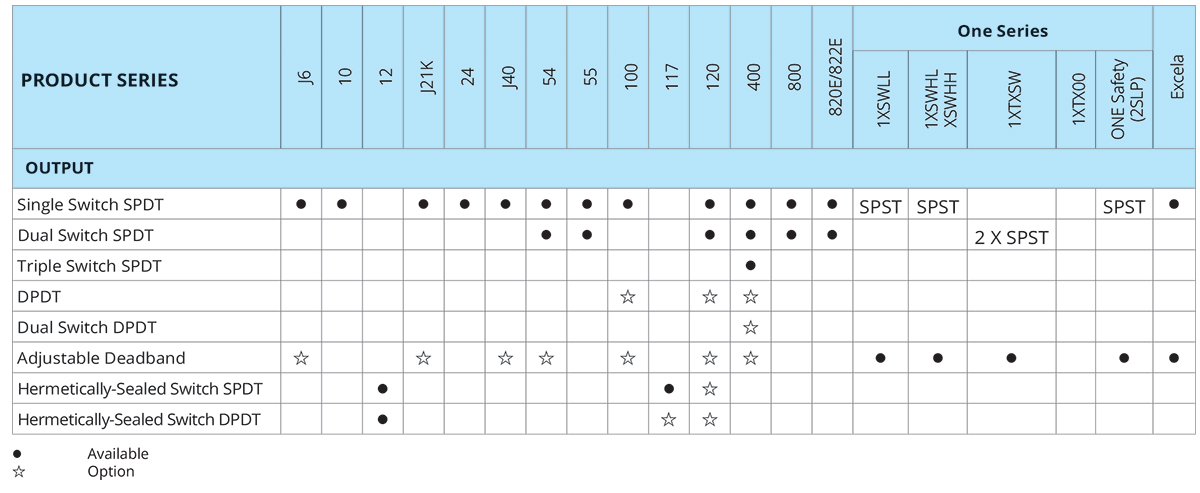
- UE product series that offer Dual switch models are: 54, 55, 120, 400, 800, and 820.
- The One Series model 1XTXSW is also a dual switch.
- The 400 Series offers a model with three independant switches.
- A DPDT switch is offered as an option for our 100, 120, and 400 Series.
- A hermetically sealed DPDT switch is offered as an option for our 12 and 117 Series.
- It is also possible to have 2 DPDT switches (available as an option on our 400 series).
Please contact us for further information or discussion.
Email: marketing@ueonline.com


