
UE’s Innovative Solution to Difficult Problems in Methane Emissions
The Importance of Natural Gas and Methane Emission Reduction
For decades, the oil and gas industry has dubbed natural gas a “transition fuel” believed to provide the missing link in the transformation of the North American energy supply from abundant, established sources like coal to emerging, renewable sources like solar and wind. After all, natural gas is widely available and clean-burning when properly handled.
However, problems arise when leaks occur in the natural gas pipeline. The main component of natural gas, methane, is a potent global warming gas 25x stronger than CO2. In order for natural gas to burn cleaner than coal or heavier hydrocarbons, less than 2% of it can leak from wellhead to burner tip.
Governments and industry alike have recognized the importance of minimizing methane emissions in the natural gas pipeline. Both the U.S. Department of Energy and the Canadian Environmental Defense Fund have implemented emissions reduction programs and devoted funding and technical assistance to solving this crucial problem. The U.S. Environmental Protection Agency has even released a final rule in March 2024 demanding stricter standards of performance for natural gas facilities constructed, modified, or reconstructed between September 18, 2015, and December 6, 2022. In addition to governmental efforts, coalitions like ONE Future (consisting of over 50 natural gas companies), are working to voluntarily reduce methane emissions across the natural gas value chain.
Whether it is mandated or not, the need for reducing methane emissions is clear. Early leak detection is particularly important because of the fact that so-called “super-emitters” are responsible for over 80 percent of all emissions while constituting less than 20 percent of leak sources in production.
Current Problems in Methane Leak Detection
Unfortunately, current methods of methane leak detection are inefficient and prohibitively expensive. Relying on human auditory, visual, and olfactory methods for detecting leaks are largely ineffective because most natural gas is colorless and odorless, and the loud sound a gas leak might produce is often obscured by noise from other equipment on-site.
Thus, some of the most commonly applied methods used in methane gas detection involve a trained expert using specialized equipment to check worksites at regular intervals. EPA method 21 means having a technician use a handheld “sniffer” to inspect potential leak points. Newer handheld laser methane detectors operate in a similar fashion. OGI cameras use infrared technology to detect temperature difference between the methane emission and the background, making leaks “visible” to a trained expert. Now, trained pilots can even fly drones equipped with cameras and natural gas detectors over worksites.
Whether old or new, these methods are greatly limited in three major ways:
- Significant costs: These methods require trained technicians or pilots, which often demand hefty payments for their labor.
- Inability to easily scale up: It is difficult to simply and inexpensively scale up gas detection operations when relying on costly technology and the labor of individuals.
- Higher risk of damage: Gas leak detection cannot occur 24/7 using these methods, meaning that a significant amount of damage can occur in between interval “check-ups.”
UE’s Solution To Challenges in Methane Leak Detection
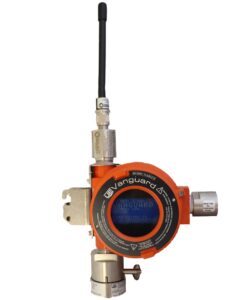 The key in reducing costs and potential damage is to separate leak detection from leak location. Once leaks are detected, an expert can be deployed to find the leak location and offer recommendations or repairs. This will save companies from wasting time, money, and resources.
The deployment of non-proprietary wireless fixed gas detectors has been a game changer for continuous emissions monitoring systems (CEMs) and predictive emissions monitoring systems (PEMs). Worksites can now be monitored around the clock, 24/7. Wireless gas detectors resolve the three significant limitations of EPI method 21, OGI, drones, and laser methane detectors:
- Reduced costs: Wireless gas detectors can be installed at many detection points for just one third the cost of wired gas detectors, while bypassing the need for interval “check-ups” with handheld detectors, OGI cameras, or drones.
- Easily scalable: Detectors can be deployed where and when needed throughout a worksite via wireless installation. No additional specialized experts are required.
- Lower risk of damage: Detectors can monitor sites 24/7, reducing the risk of damage caused by delayed detection.
Using wireless gas detectors based on open, nonproprietary communications protocols, such as WirelessHART, can add even more cost savings and flexibility. HART is the most commonly used industrial protocol, which means that many companies already have networks in place, making it easier to plug in for secure data transmission.
Additional benefits of wireless gas detectors are easier calibration, universal mounting, and ability to change batteries and sensors in classified areas without a hot work permit. Modern battery-powered detectors can even run up to five years without needing to recharge the battery, reducing costs further by simplifying maintenance and installation.
Even in the face of new technologies, UE’s wireless gas detectors remain a relevant solution to the gas detection challenges many worksites face. As the use of natural gas continues to grow, the need to minimize leaks in storing and transporting will grow with it. With wireless gas detectors, we can all enjoy a cleaner environment and safer, more economical natural gas operations.
Please contact us for further information or discussion.
Email: marketing@ueonline.com


